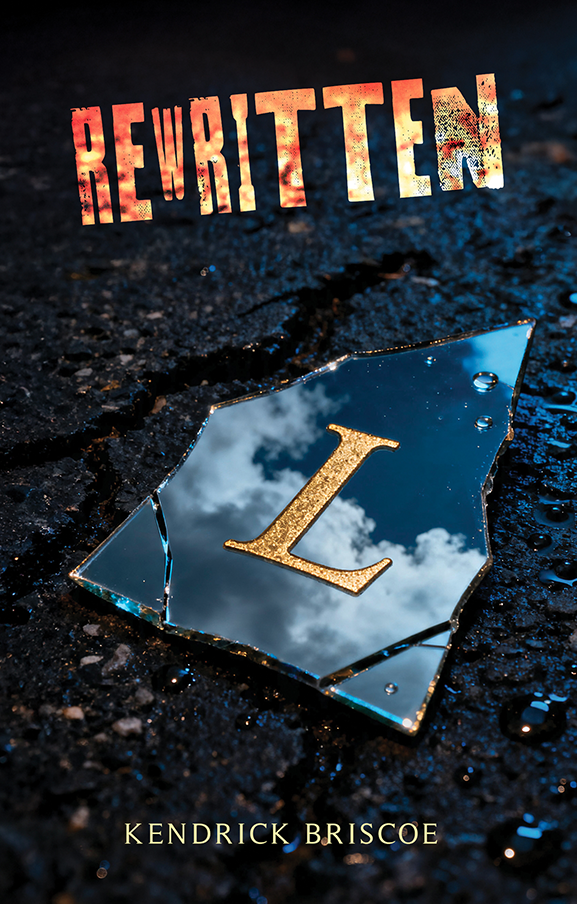
Rewritten
Granville Morris is fifty-five. Successful by most measures — and quietly coming to terms with the fact that success isn’t everything.
Then he collapses on a Leeds street.
As the sirens fade, he finds himself floating above City Square, drawn towards somewhere peaceful, a strange voice guiding him. This is it, surely. This is how it ends.
Or is it?
Because Granville wakes in the Leeds of April 1992 — face to face with his younger self, and with the chance to become the mentor he never had, and to put right the mistake that has haunted him for thirty years: losing Emma.
A story about second chances, and whether we’d really take them.
Would you like a signed copy? Get in touch
What the readers say
It’s a thought-provoking story line and one that makes you reflect on the choices we make and the things we might do differently if given a second chance.
★★★★★ Amazon reader
A fantastic book that keeps you guessing right up until the end.
★★★★★ Amazon reader
Read an extract
The Brown Cow
Leeds, April 1992. Granville has just seen the date on the paper.
‘You going in to buy that, or just going to stand there staring at it?’
A slightly overweight man in a wax jacket was trying to get past him into the shop, his expression hovering somewhere between irritation and bewilderment.
‘Sorry — yes, I’m in the way.’ Granville stepped aside automatically, still barely able to move, the newspaper hanging loosely in his hand.
‘It’s 1992,’ he said aloud.
The man in the wax jacket said nothing, but shot him a look of mild concern before disappearing inside.
Granville placed the newspaper back in the stand and walked away from the shop. He wasn’t aware of making the decision to walk. His legs just moved, carrying him along the pavement on autopilot while his mind tried and failed to make sense of what his eyes had just told him. The date had been printed right there in plain black ink. Saturday, 4th April, 1992. Not a misprint. Not a joke. Just a fact, sitting there on the front page of a newspaper, waiting for him to accept it.
He couldn’t.
He found himself at the pelican crossing and stepped out into the road without pressing the button, without looking, without thinking.
A horn blared.
He turned his head and had just enough time to register a blue transit van bearing down on him before the brakes locked and the tyres screamed across the tarmac. The van shuddered to a halt inches from where he stood. Granville’s hands went to the bonnet instinctively, pressing flat against the metal. The heat of the engine came through immediately, burning his palms, and he snatched them away.
The driver’s window dropped. ‘You got some sort of death wish, mate?’
Granville looked at him. He couldn’t think of a single thing to say.
‘1992,’ he said quietly to himself.
The driver stared at him for a moment, shook his head and pulled away.
Granville stood motionless in the middle of the road until a gentle hand appeared at his elbow.
‘Are you all right, sir? You look like you’ve had a shock.’
A man in his early sixties was guiding him carefully across the rest of the road — unhurried, steady, the kind of man who simply got on with things without making a fuss about it. He was carrying a plastic carrier bag and wore the expression of someone who had seen people in distress before and known what to do.
He steered Granville gently to a bench outside the carpet shop and they both sat down.
‘Have you had some bad news? You look very pale.’
Granville nodded slowly. ‘Yes. I’ve had a shock. I’m not entirely sure what’s happening.’
The man looked at his watch, then back at Granville. ‘Would you like a warm drink? The church hall does tea and coffee on a Saturday afternoon — we could head over there.’
‘No, really — I don’t want to be any trouble.’
‘It’s no trouble at all — I’m going there myself.’ The man smiled, and it was the kind of smile that was difficult to refuse. ‘Or, if you’d prefer something stronger…’ he nodded in the direction of the Brown Cow, ‘there’s always that option.’
He leaned forward slightly and extended his hand. ‘I’m Alf.’
‘Granville. Granville Morris.’
He looked across at the pub — The Brown Cow. His old local. He knew it well, well enough to picture the low hum of voices in the tap room and the smell of beer and cigarettes, though he hadn’t been the sort to be in there every night. If anything, he’d kept himself away more than he needed to. And if he was honest, he might have been better off spending a few more evenings there — laughing, chatting, generally having fun — instead of sitting alone in his bedroom with his books. It had been nearly thirty years since he’d last set foot inside.
‘Something stronger,’ he said. ‘Yes. I think so. I’ve no money on me though.’
‘This one’s on me,’ Alf said simply, and stood up. ‘Come on.’
They walked the short distance to the Brown Cow and made their way around to the back entrance. The door to the tap room was an old wooden affair with ‘TAP ROOM’ picked out in stained glass across the window. Alf pushed it open and held it for him.
Granville took two steps inside and stopped.
The pool table sat in the centre of the room, the dartboard hung to the left as you walked in, and the bar occupied a small alcove at the far end. Three pumps lined the counter: Tetley’s Bitter, Tetley’s Mild, Castlemaine XXXX. A low murmur of conversation filled the room and somewhere behind the bar a phone rang with nobody bothering to answer. The smell of the place — beer and old wood and something faintly like coal — hit him like a memory made physical.
‘It’s exactly as I remember it,’ he said quietly, more to himself than to Alf.
‘You’ve been in before then?’ Alf asked.
Granville gave a small, quiet laugh. ‘Yeah. About thirty years ago.’
He stood looking at the bar and let his eyes drift to the pumps. He’d had his first proper pint in here — late eighties, Tetley’s Mild, ninety-six pence, and he’d thought himself enormously sophisticated.
‘What would you like to drink then?’ Alf asked.
‘Pint of mild, please,’ he said.
‘Coming right up.’ Alf walked to the bar with his plastic carrier bag rustling at his side.
Granville took a seat at one of the tables that surrounded the pool table and waited. A moment later Alf returned, carrying two pints and concentrating intently on not spilling a drop. He set them down, lifted his glass and brought it against Granville’s with a satisfying chink.
‘Cheers. Good health.’
‘Cheers.’ Granville took a long swig of the mild. It was cold and malty and tasted of nostalgia if that was at all possible.
‘Decent pint,’ Alf said approvingly. ‘So — bad news, was it? That van nearly flattened you.’
‘Something like that. I was just… overwhelmed.’
‘I’m not one to pry,’ Alf said, and meant it. ‘As long as you’re all right now.’
Granville nodded. ‘I’m fine. Thank you — and thank you for the drink.’
‘My pleasure. You got family round here?’
Granville allowed himself a wry smile. ‘Yeah. Though I haven’t seen them for years.’
‘Might be a good time to look them up,’ Alf said gently.
The door from the lounge into the tap room swung open.
A young woman came through first, laughing at something, already mid-sentence, a lad following close behind her trying to keep up. They brought a burst of energy with them, the easy, unself-conscious kind that belongs to people in their early twenties who don’t yet know how quickly it goes.
Granville looked up.
The glass stopped halfway to his mouth.
‘Oh my god,’ he breathed. ‘Emma.’
She was exactly as he remembered her. Auburn hair in loose curls, falling around her face. Green eyes, bright and quick, always suggesting she was on the verge of either laughter or mischief. She was wearing tight denim jeans and a baggy cable-knit blue jumper, and she moved through the room with the careless confidence of someone who had no idea how captivating she was. Which, Granville knew, was precisely what made her captivating.
And then his eyes moved to the lad.
It’s me, he thought. Me.
Brown hair, floppy, centre parting. Slim — not in the way that came from effort, just in the uncomplicated way of a young man who hadn’t yet discovered the particular consolations of takeaway food and late nights in the press room fuelled by sugary energy drinks. He looked easy in himself in a way that older Granville had entirely forgotten.
He was watching Emma. She had stationed herself at the dartboard and was already pulling darts from the board with theatrical confidence.
‘So, if I throw a bullseye, you buy me a drink?’ she said, turning to grin cheekily.
‘You know those two?’ Alf asked quietly, clearly having noticed the way Granville was observing the couple.
‘The lad,’ Granville said carefully. ‘We’re… erm, related.’
‘Well,’ Alf said, pushing back his chair and draining the last of his pint, ‘that’s good timing then. Because I should have been in the church hall with my sister…’ he looked at his watch and winced, ‘…about twenty minutes ago.’ He picked up his carrier bag and stood. ‘I’ll leave you to catch up with your young relative.’
‘Thank you, Alf. For the drink. For all of it.’
‘Not a problem.’ Alf smiled and buttoned his coat. ‘You take care of yourself. Especially crossing that road.’
He gave a small wave and headed for the door.
Granville watched him go, and felt something close to gratitude settle in his chest. Then a shriek of triumph cut through the room.
‘YEEEAAAHHH!!! BULLSEYE!’
Emma was bouncing on her heels, arms raised, breaking into a wide grin.
‘Doesn’t count,’ young Granville said flatly, though the corners of his mouth were fighting a smile. ‘It was supposed to be within three darts. You’ve thrown about twelve.’
Emma leaned against the partition between two tables, tilted her head to one side like a curious cat, eyes wide, lips curling into a slow grin. ‘I say it counts. And I say — one Bacardi and Coke, please.’
Young Granville shook his head, clearly already defeated, and made his way to the bar.
Behind the book
When it’s not your time…
This book grew out of something that happened to a relative of mine, who woke from a coma. I was just a kid, but I remember being told she’d only woken up because she’d been “sent back, as it wasn’t her time”.
It got me thinking. What if you weren’t just sent back — but sent back, to any point in your life? What would you do differently?
Details
| Formats | Paperback · Kindle |
| Pages | 220 |
| Size | 5 × 8 in |
| Published | May 2026 |
| ISBN | 9798199167659 |
Would you like a signed copy?
Signed and dedicated paperbacks, posted from the UK. Drop me a line with who it’s for and where it’s going, and I’ll send you a price including postage.